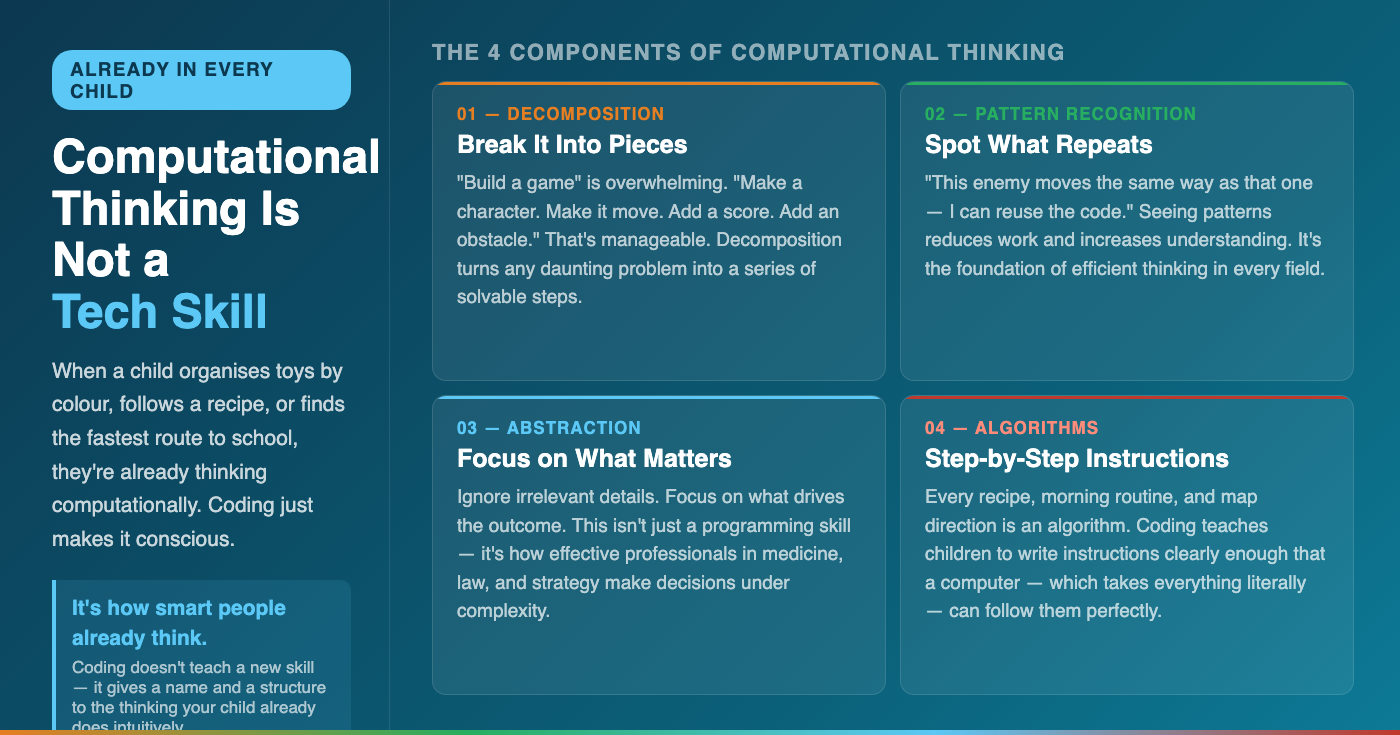
"Computational thinking" sounds like something out of a computer science PhD programme. It isn't. It's something your child already does, just not deliberately.
When a child figures out the fastest route to school, they're using computational thinking. When they follow a recipe, adjusting quantities for fewer people, they're using it. When they organise their toys by size, colour, or type — computational thinking.
Coding just makes this process conscious and repeatable.
Four skills, not one
The Brookings Institution identifies four components of computational thinking. They sound academic. They're not.
Decomposition: Breaking a big problem into smaller parts. "Build a game" is overwhelming. "Make a character. Make it move. Add a score. Add an obstacle." That's manageable.
Pattern recognition: Spotting similarities. "This enemy moves the same way as that one. I can reuse the same code." Efficiency through observation.
Abstraction: Ignoring irrelevant details. The character's colour doesn't affect how it moves. Focus on what matters.
Algorithms: Creating step-by-step instructions. Not just solving a problem, but solving it in a way that works every time.
Why it matters beyond coding
Here's what most "teach kids to code" advocates get wrong: they focus on the code. The code is the vehicle, not the destination.
Computational thinking transfers to everything. A child who learns to decompose a coding problem will decompose an essay assignment the same way. A child who learns to spot patterns in code will spot patterns in maths, in music, in nature.
Research from the World Economic Forum consistently lists computational thinking among the top skills needed for future jobs — not because everyone will be a programmer, but because everyone will need to think systematically.
How parents can nurture it
You don't need to code to teach computational thinking. Ask your child:
- "What's the smallest step we could take first?" (Decomposition)
- "Have we solved something like this before?" (Pattern recognition)
- "What details don't matter right now?" (Abstraction)
- "What would someone else need to know to do this?" (Algorithms)
These questions turn everyday activities into thinking exercises. Cooking dinner becomes algorithm design. Cleaning a room becomes decomposition. Planning a trip becomes pattern recognition.
The bottom line
Computational thinking is not about computers. It's about clarity. About approaching complex challenges with confidence and method. About knowing that big problems are just collections of small, solvable ones.
That's what we teach at CodeImpact. The code is just how we get there.
Ready to start your coding journey?
Join thousands of students across Africa who are learning to code with CodeImpact's affordable and accessible programs.