Learning Isn't a Mystery — We've Just Been Looking at It Wrong
We've all been there. You read the same page three times, and the next morning it feels like you never saw it. You explain a concept to someone—clearly, logically—and they just stare at you blankly.
That's not failure. That's learning doing what learning does: resisting shortcuts.
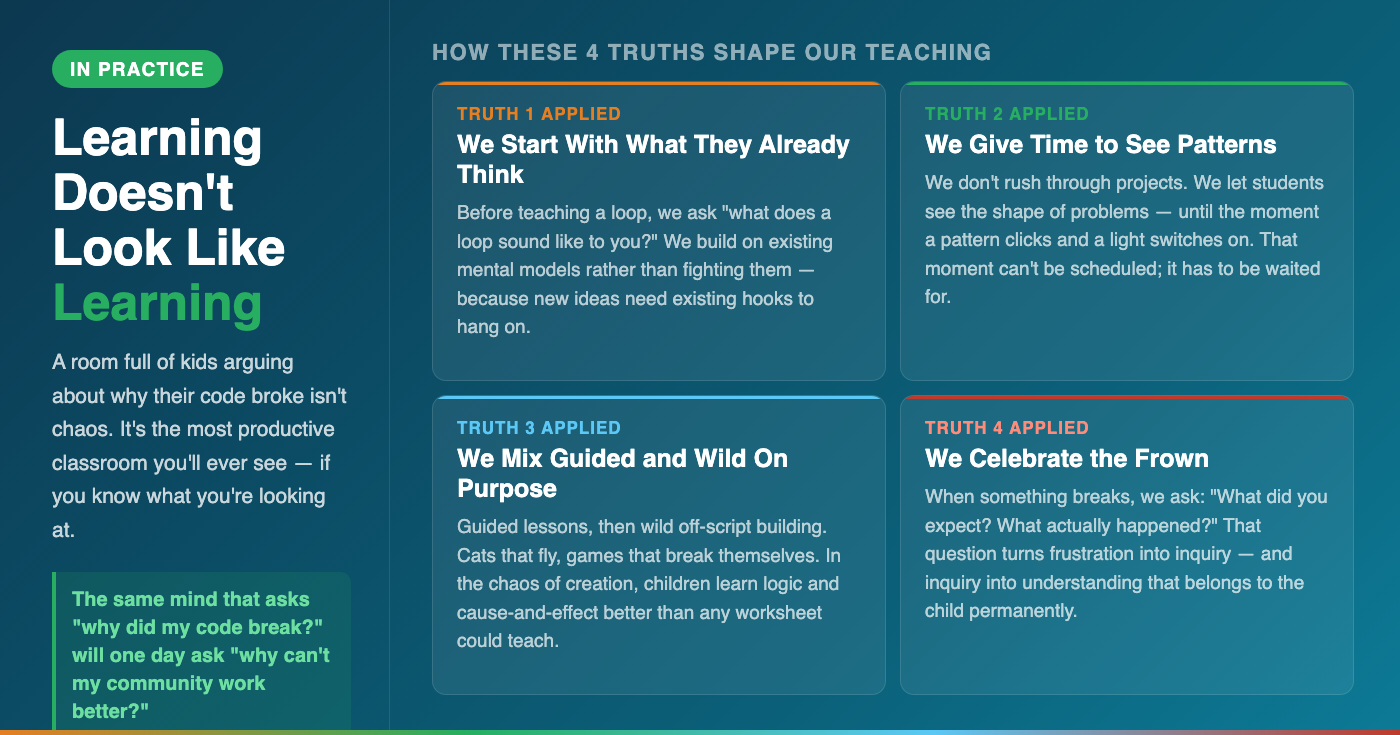
At CodeImpact, we see this every weekend when kids are learning to code. They drag a block, expect it to work, and when it doesn't, they frown, tinker, and try again. That moment of confusion—the frown—is where real learning begins.
Modern research confirms what good teachers and curious kids have always known: learning isn't about downloading information into the brain. It's about wrestling with it until it becomes yours.
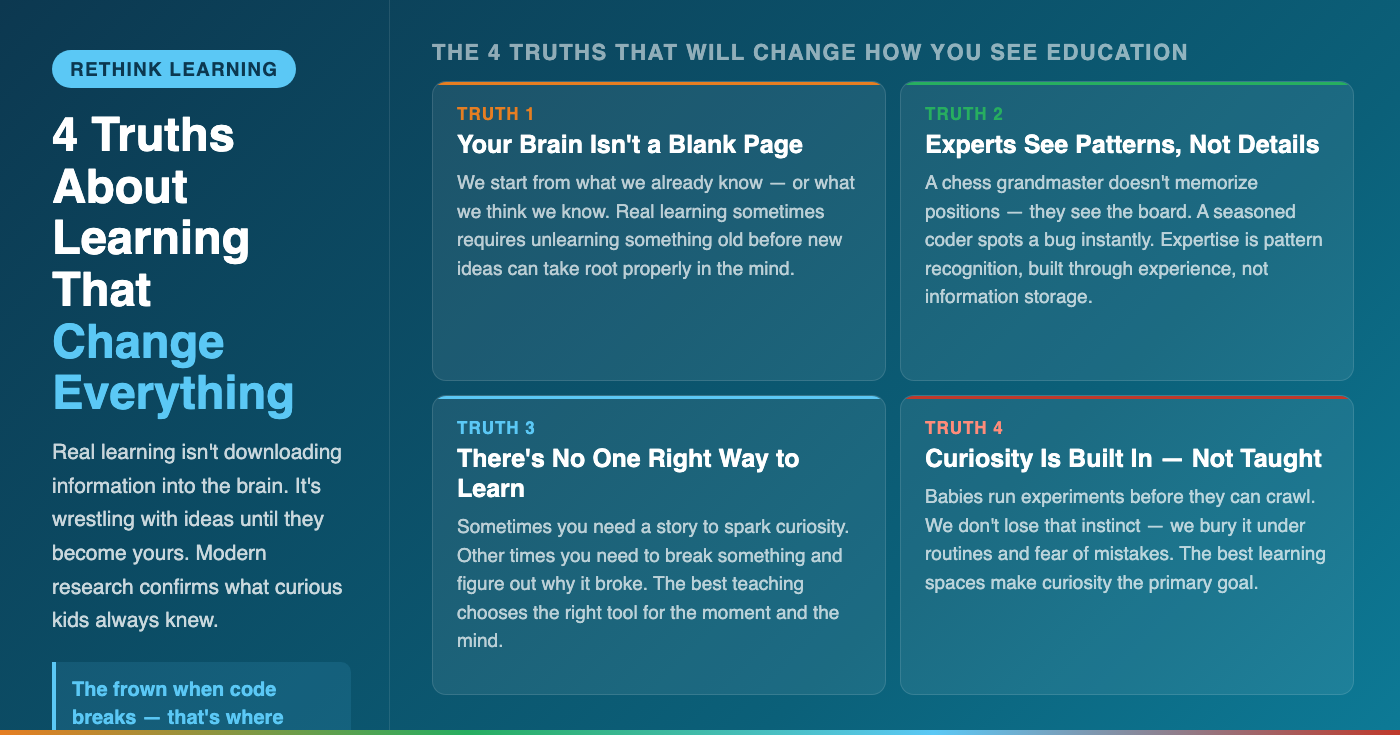
Here are four truths that can change how you see learning, whether you're a teacher, a parent, or a lifelong learner.
1. Your Brain Isn't a Blank Page
People don't start from zero. We start from what we already know—or what we think we know.
When a kid in our coding class imagines a "loop," they often picture a physical circle before understanding it's a repeating action. Their brain is connecting the new to the familiar. That's not a problem; it's how we're wired. But it means that learning something new sometimes requires unlearning something old.
If you tell someone the earth is round, they might picture a flat circle. If you teach a beginner that "the computer follows instructions," they might imagine the computer actually thinking.
Real learning starts when we challenge those old pictures and rebuild them. That's what we do at CodeImpact. We don't teach kids to memorize how code works; we help them rethink what they think they know.
2. Confusion Is a Feature, Not a Bug
We celebrate clarity. We should celebrate confusion.
Confusion means your brain is working. It means old assumptions are colliding with new information. It means you're on the edge of understanding something.
When a child's Scratch project doesn't work, we don't rush to fix it. We ask: "What did you expect? What happened instead?" The confusion becomes data. The debugging becomes discovery.
3. Transfer Is Hard (But Worth It)
Learning something in one context doesn't automatically mean you'll use it in another. A child who learns loops in Scratch won't necessarily see loops in their daily life.
That's why we focus on patterns, not just syntax. We ask: "Where else have you seen something repeat?" Morning routines. Days of the week. Heartbeats. The loop concept lives everywhere.
4. Learning Is Social
We think of learning as something that happens inside individual brains. But the research is clear: we learn better together.
At CodeImpact, pair programming isn't just about productivity. It's about thinking out loud, explaining your reasoning, hearing different approaches, and building shared understanding.
The child who explains their code to a peer understands it better than the child who only runs it silently.
The Bottom Line
Learning isn't a smooth curve. It's a messy, iterative, social process of challenging assumptions, sitting with confusion, and slowly rebuilding understanding.
Our job as educators isn't to make learning easy. It's to make it meaningful. To create moments where kids (and adults) feel the satisfaction of "getting it" after the struggle of almost getting it.
That's the CodeImpact way.
Ready to start your coding journey?
Join thousands of students across Africa who are learning to code with CodeImpact's affordable and accessible programs.