Every parent I meet has the same guilt: "My child spends too much time on screens." And every time, I ask the same question: "Doing what?"
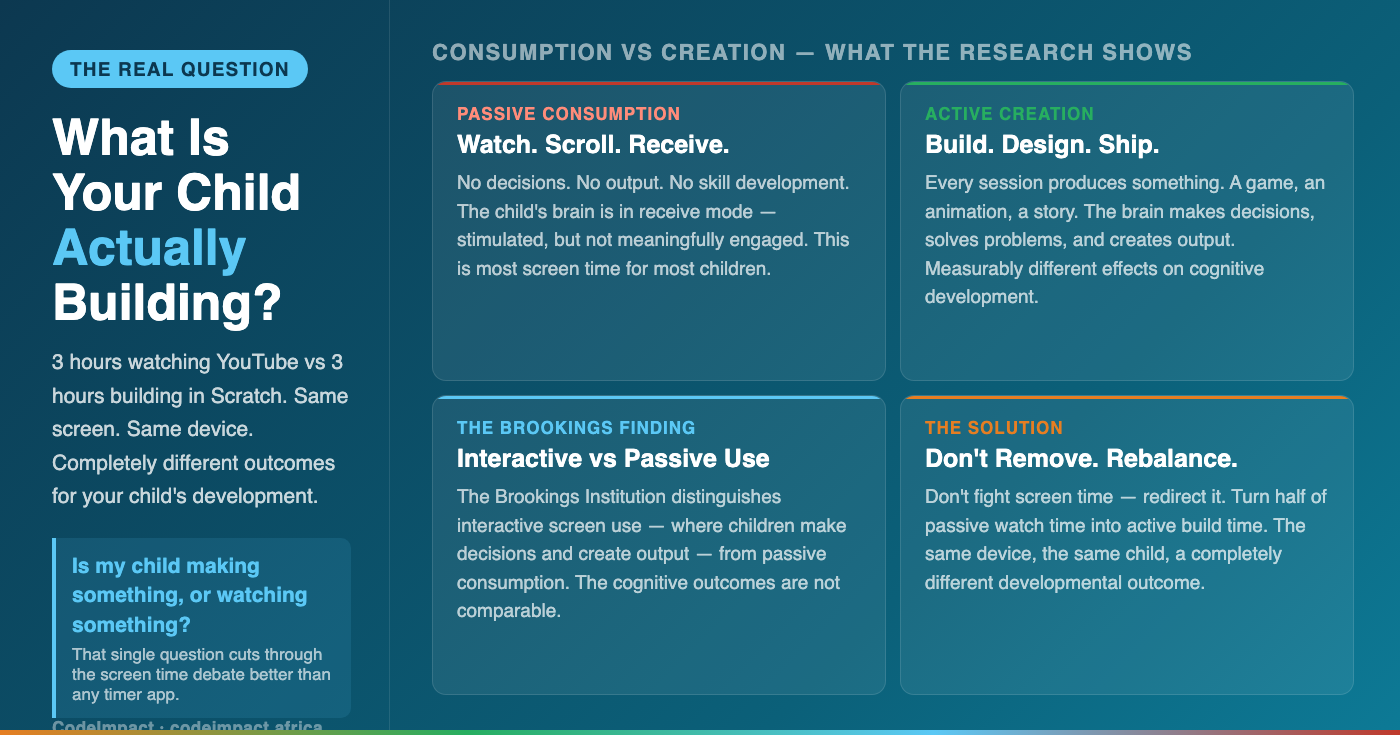
Because there is a canyon-wide difference between a child watching YouTube for three hours and a child spending three hours building a game in Scratch. Both involve a screen. One is consumption. The other is creation.
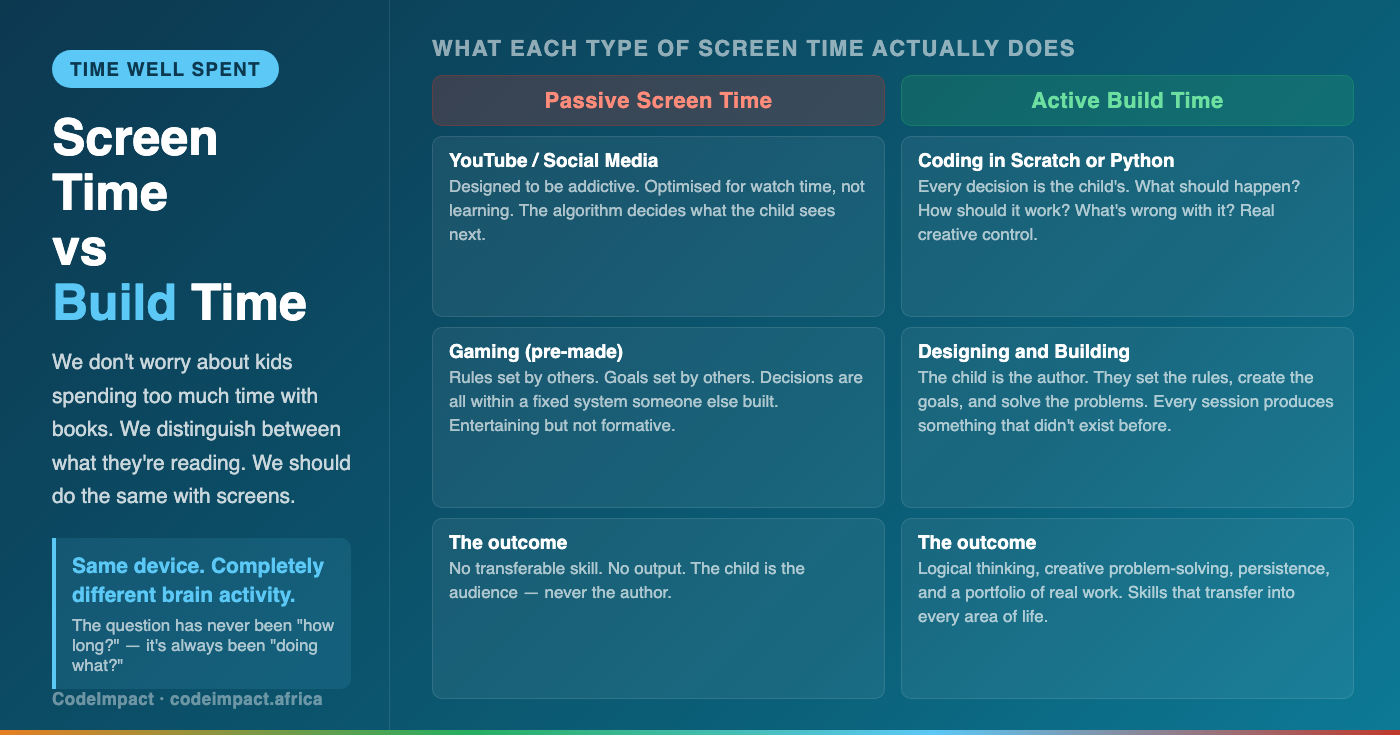
We don't worry about kids spending "too much time with books." We distinguish between reading trashy magazines and reading literature. We should do the same with screens.
The Consumption Trap
Most screen time is passive. Scrolling feeds. Watching videos. Playing games designed by someone else. The child's brain is in receive mode. Stimulated, yes. Engaged, not really.
The Brookings Institution calls this the difference between "interactive" and "passive" screen use. Interactive use — where the child makes decisions, solves problems, and creates output — has measurably different effects on cognitive development than passive consumption.
The distinction isn't complicated. Ask: is my child making something, or watching something?
 Build Time Is Different
When a child codes, they're doing several things simultaneously:
- Planning — What do I want to build? What should happen first?
- Problem-solving — This isn't working. Why? How do I fix it?
- Creating — They're making something that didn't exist before.
- Iterating — Version 1 is rough. Version 2 is better. Version 3 is something they're proud of.
This is cognitively demanding work. It builds the same muscles as writing an essay, solving a maths problem, or designing a science experiment. The screen is just the canvas.
The Research Backs This Up
MIT's research on Scratch shows that children who code regularly develop stronger computational thinking skills — the ability to break complex problems into manageable parts. This transfers directly to maths, science, and everyday reasoning.
The UNESCO Global Education Monitoring Report highlights that digital literacy — not just digital access — is critical for educational outcomes in developing countries. Access without skills is just more screen time.
A Practical Framework for Parents
You don't need to ban screens. You need to redirect them. Here's a simple rule:
For every hour of consumption, aim for 30 minutes of creation.
Watched a YouTube video? Great — now open Scratch and try to build something inspired by it. Played a game? Cool — what if you designed your own level? This isn't punishment. It's balance.
Turn screen time into build time
In a single Hour of Code session, your child goes from watching to building. They'll create their first project and experience what productive screen time feels like.
Stop Feeling Guilty. Start Being Intentional.
The screen time debate is a distraction. The real question is what your child does with their time — on screen or off. A child building a game is learning more than a child passively watching a documentary.
Give them the tools to create, and the screen becomes an asset, not a worry.
Ready to start your coding journey?
Join thousands of students across Africa who are learning to code with CodeImpact's affordable and accessible programs.