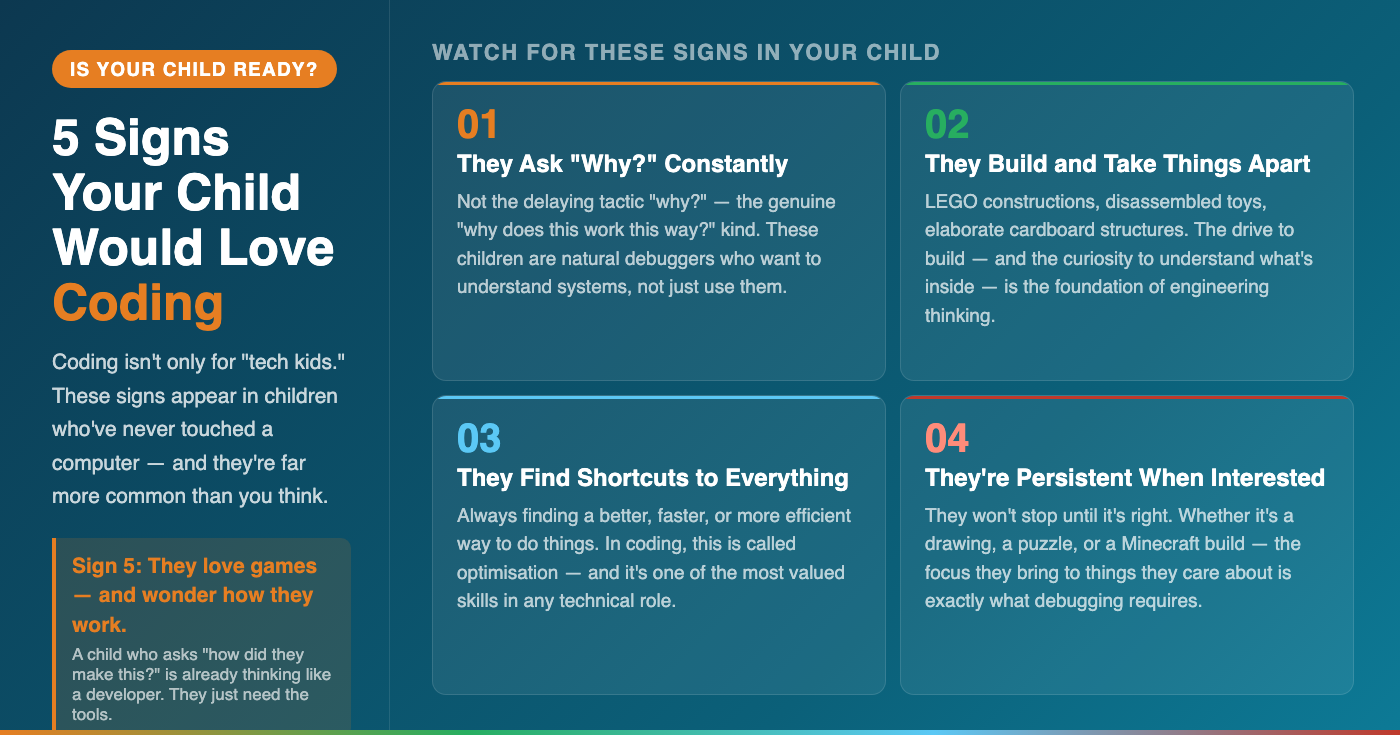
Parents often tell me, "My child isn't really a tech kid." As if coding is only for children who already sit in front of computers all day. It's not. Some of our best students are the ones who came in knowing nothing about technology.
Coding isn't about being "techy." It's about thinking in a particular way. And many kids already think that way — they just haven't had a name for it.
Here are five signs your child would probably love coding.
1. They ask "why?" constantly
Not the lazy "why" that kids use to delay bedtime. The genuine "why does this work this way?" kind.
Why does the light come on when I flip the switch? Why does the ball bounce higher when I throw it harder? Why does the app crash when I tap too fast?
These children are natural debuggers. They want to understand systems. Coding gives them a system they can explore, break, and rebuild — with immediate feedback.
2. They build things (anything)
LEGO structures. Cardboard forts. Elaborate sandcastles with drainage systems. Jewellery. Origami. Paper aeroplanes optimised for distance.
The medium doesn't matter. The instinct to build does. Coding is building with logic instead of bricks. Same impulse, different material.
Research from the MIT Media Lab calls this "constructionism" — the idea that children learn best when they're actively making things, not passively receiving information.
3. They notice patterns
"Mum, these tiles alternate two colours." "Dad, every third song on this playlist is slow." "The traffic lights always go green-yellow-red, never green-red-yellow."
Pattern recognition is one of the four pillars of computational thinking, according to researchers at Brookings. Children who naturally spot patterns in their environment are wired for programming, where finding and exploiting patterns is the entire game.
4. They make up rules for games
Not just playing games — inventing them. Modifying the rules of existing games. "What if in tag, you could freeze someone by touching them with your left hand, but only if you're standing on grass?"
This is algorithm design. They're defining conditions, exceptions, and edge cases. They're programming — just with words and playground rules instead of code.
5. They get frustrated when things don't make sense
This one surprises parents. Frustration is a feature, not a bug.
A child who gets annoyed when something isn't logical — when rules are inconsistent, when a system seems arbitrary — has the exact temperament for coding. In programming, everything has a reason. Nothing is arbitrary. If something doesn't work, there's always a specific cause.
For children who crave that kind of consistency, coding is a relief. The computer doesn't have moods. It does exactly what you tell it. Every time.
Recognise your child in any of these?
One session is enough to know. Our Hour of Code lets your child try coding with zero commitment and zero experience.
Book Hour of CodeThe sign that matters most
Honestly? None of these five signs are prerequisites. Plenty of kids who don't obviously fit any of these descriptions discover a love for coding once they try it.
The only real sign that matters: your child hasn't tried coding yet. That's not a problem. That's an opportunity.
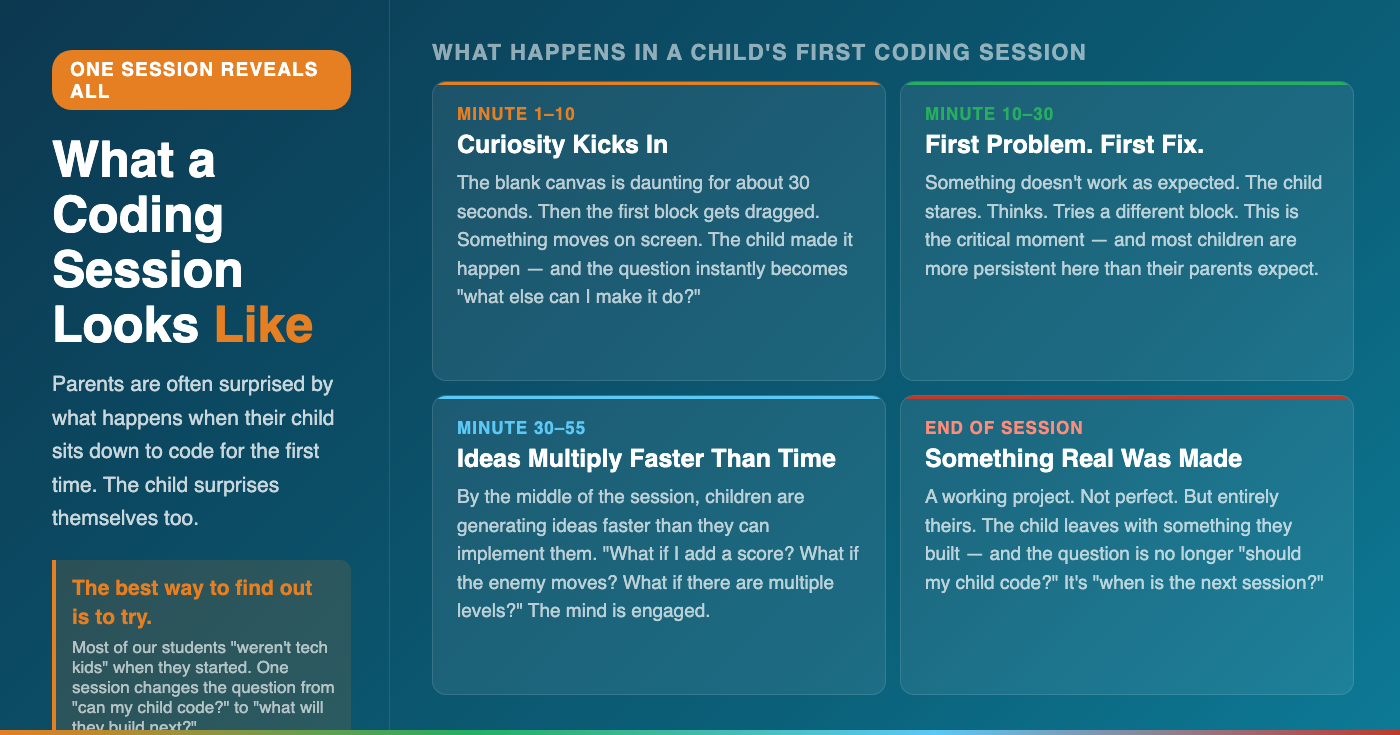
The Only Way to Know Is to Try
One hour. One project. That's all it takes to find out if your child loves coding.
Try Hour of CodeReady to start your coding journey?
Join thousands of students across Africa who are learning to code with CodeImpact's affordable and accessible programs.