Sarah's mum signed her up because she was "spending too much time on the iPad." That was the entire motivation. Not STEM careers. Not future-proofing. Just a parent hoping for something more productive than YouTube Kids.
Fair enough. That's how most families find us.
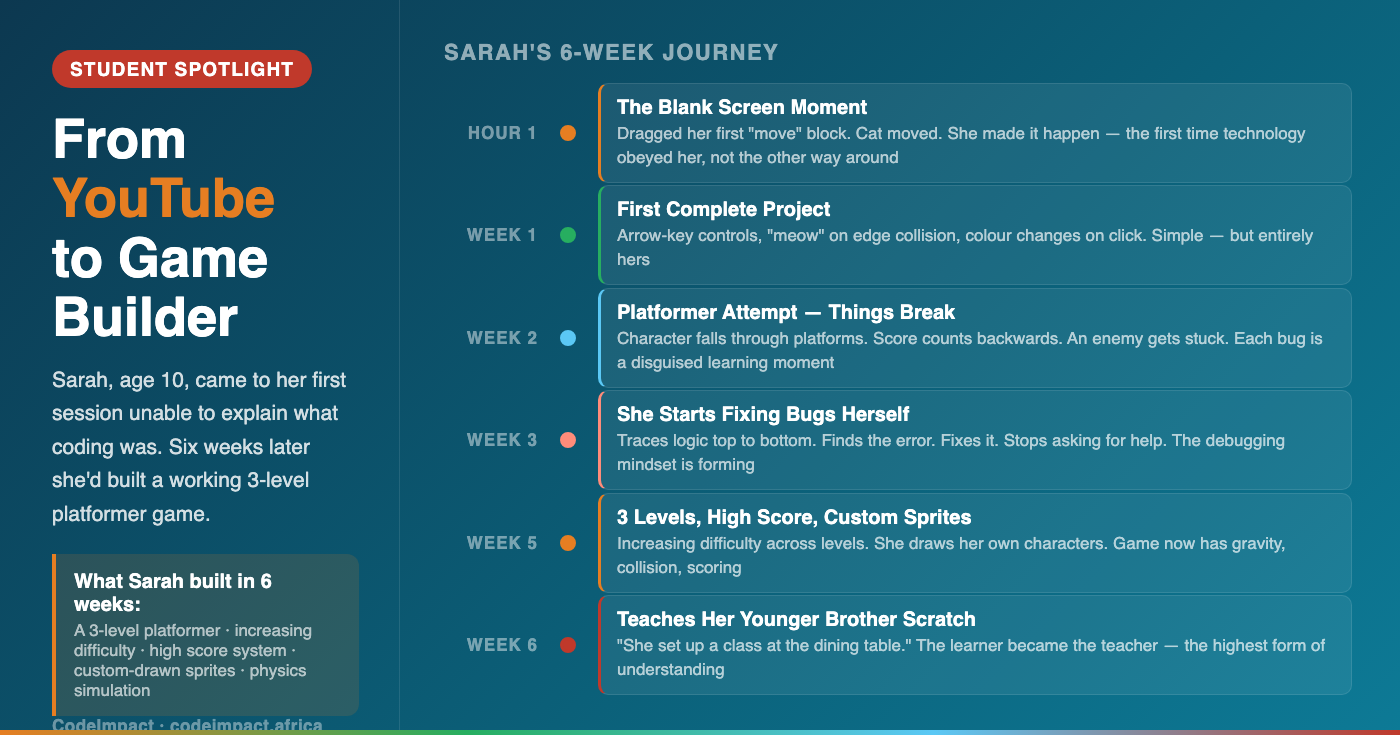
Week 1: The blank screen
Sarah's first session was an Hour of Code. She sat down, looked at Scratch, and said, "What do I do?" Her mentor showed her how to drag a "move" block onto the canvas. She pressed the green flag. The cat moved.
That was the moment.
Not because moving a cat is impressive. But because she made it happen. She told the computer to do something, and it did. For a 10-year-old who'd only ever been told what to do by computers (tap here, swipe there, watch this), the reversal was powerful.
By the end of that first hour, she had a cat that moved with arrow keys, said "meow" when it hit the edge, and changed colour when clicked. Not sophisticated. But hers.
Weeks 2–3: Things break. She fixes them.
Sarah enrolled in our Holiday Program. She wanted to build a platformer — a game where a character jumps between platforms, avoids enemies, and collects coins. Classic stuff.
It didn't go smoothly. Her character fell through platforms. The score counter counted backwards. An enemy sprite got stuck in a corner and refused to move.
Each of these bugs is a learning moment disguised as frustration. Her mentor's job wasn't to fix them. It was to ask the right questions. "What did you expect to happen? What actually happened? Where do you think it went wrong?"
Sarah started developing a habit: when something broke, she'd stare at her blocks, trace the logic top to bottom, and find the problem. She stopped asking for help with bugs by week 3. She started fixing them herself.
Weeks 4–6: Teaching others
By week 4, Sarah's game had three levels, a scoring system, and sound effects. It wasn't polished — the art was basic, some collisions were forgiving — but it worked. You could play it start to finish.
Then something interesting happened. Her younger brother (age 7) watched her play and wanted to try. Sarah became the teacher. She showed him how to drag blocks, how to test after every change, how to think through what should happen.
She was explaining loops and conditionals without knowing those words. She just knew what worked.
The outcome
Six weeks after her first Hour of Code, Sarah had:
- A working platformer game she built herself
- The confidence to debug her own code
- The ability to teach coding concepts to her brother
- A new way of looking at technology ("I could make that" instead of "I wish I had that")
Her mum reports that she's still on the iPad — but now she's building games instead of watching videos. That's the difference.
Ready to start your coding journey?
Join thousands of students across Africa who are learning to code with CodeImpact's affordable and accessible programs.